Saturday, November 13, 2010

Rutland Round 6 - Clipsham to Whissendine

With Marta. Fine, sunny, very warm. A few dry ploughed fields to cross. garmin fail between Teigh and part way to Whissendine - human error. About 13 miles in all.

The first part of this walk was a little uninspiring - along the road from Clipsham to Stretton, though we discovered that we could have walked a little further from the verge, too late for today.


We followed the road to the roundabouts under the A1. Our path left the slip road for the A1 North, via a plank bridge and a stile.


The route lies across a large grassy field, and crosses a concrete track, then another bridge and field before joining a minor road.


A very free range hen

At the road we turned right and walked up to the bend in the road, where a path goes to the right. At this point we had some difficulty, and lost the waymarks. When we came out at the road as the map route showed, we were still unsure, and diverted slightly to join another path which took us back to our route more easily.


This was near the flight path and approach lights for RAF Cottesmore. This now known as the Army's Kendrew Barracks.


Soon after crossing the old flight path, we had a quick break, before following the route into Thistleton. John Williams's book and the waymarking helped make this straightforward.


Thistleton, the most northerly village in Rutland, is very small, but has a fine church and a herb farm.


St Nicholas church, Thistleton

From Thistleton, we took the road west towards Sewstern - and carried on until we reached the point known as Thistleton Gap, where Rutland meets Lincolnshire and Leicestershire.


From wikipedia:


On 28 September 1811 a massive crowd of up to 20,000 watched aprizefightat Thistleton Gap.Tom Cribbfought the AmericanTom Molineauxin a hotly contested re-match for the heavyweight championship of England. The match was a matter of national pride and the names of both these men were famous throughout the land. The venue was chosen as the three counties of Rutland, Leicestershire and Lincolnshire met there and if the police arrived to halt the illegal fight the boxers and crowd could escape across the county boundary. In the eleventh round Cribb knocked out Molineaux. The original match, a year before, had ended in exhaustion for both men after a gruelling 33 rounds with accusations of cheating. During the intervening period both men had lost weight; Cribb because of extensive training with the famous Captain Barclay and Molineaux due to loss of muscle whilst earning his keep at local prizefighting venues.[7]


The barns near Thistleton Gap

We recognised the spot by the county boundary sign, and two large barns on the left hand side of the road.


Shortly after the barns we had to cross another ploughed field, diagonally right to the corner of the hedge. After this it was a case of following the path and waymarks along field boundaries. With the hedge on our right we could see a house - Cribb's Lodge, which is reputed to be the training base for his bare-knuckle fights.


We continued with the hedge on our right, ignoring a path and stile on the right. We had to turn left then right with the field boundaries, joining a farm track just before a small industrial estate on our left. We carried on skirting some woodland, still with the hedge on our right. As we were on the south side of the hedge for most of the time, this was hot going, and the views weren't up to much for a while! We had another break when we found a suitably shady spot - at last.


Just after walking past the wood there is a shadier path, with wider views - quite a relief!


We turned left and later right around the wood's edge. The path is crossed by a path towards Edmondthorpe. We had to turn left at a point where a bridleway goes straight ahead.

Use the book and the OS maps here - much clearer than my description!

At the end of the last field is a gate, near the disused Melton to Oakham Canal. The track goes over the canal.


The disused Oakham to Melton Canal

As instructed we headed slightly to the right across the field to a gate in the right hand hedge. This led on to a track. When the track met the road, opposite Catmose Lodge, we turned left towards Teigh. (TEE?) but no tea :-(.


We walked past a road to the right signposted to Whissendine, then just after the Teigh sign we turned right into the village and on to the imposing church. It wasn't open at the time, so that'll be one for another day.


Holy Trinity church, Teigh

The path leaves just over the road opposite the west end of the church. The waymarks are easy to follow here - there's even one on its own in the middle of the first field. We went quite close to an area of water and saw two herons flying from there. A footbridge and a stile, then a longish section with the hedge on our left was next, leading to this rather long thin footbridge:


Not quite a rope bridge over a chasm, but . . .

After this we took the path diagonally right across a field and through a gateway in the opposite hedge. We emerged on to a bridleway, turned right and then crossed the Leicester-Peterborough railway line. You can see for a fair distance each side, and judging by the train which came along soon after we'd crossed, you can hear the trains coming.


'Pill-box' remnant of World War 2 defences


Our path was along the bridleway for a good mile gradually uphill until it met the road to Whissendine. We turned left, and in a couple of hundred yards took a footpath to the right, over a stile.


Whissendine windmill from the path


We crossed the field to the stile opposite and came out near St Andrews Church in Whissendine.


From here it was all downhill to the village centre, the shop for a sandwich and some liquid, and back to a circular seat on the village green, where we ate our food.


Thursday, November 11, 2010

Outdoor Cafe

I loved the colors I found in this outdoor cafe off of a coffee shop. There was no one there so we took the time to take several photos of the umbrellas, Spanish style table and chairs, ristras, and flowers in their little garden.

Magic in Vermont: the Old Spokes Home

Old Spokes Museum

Over the weekend, a bunch of us (it was actually an entire delegation) made our way from Boston, MA to Burlington, VT for the New England Randonneurs Vermont Fall Classic. The ride was to begin early in the morning on Sunday, and since Burlington is quite a distance away most of us arrived the day before. There are many interesting things to do in the area, but the destination I truly wanted to visit was the Old Spokes Home. When I described it to my companions Bikeyface and Vorpalchortle, they agreed that we must see it immediately.


Old Spokes Home

Rolling into town in the pouring rain, we headed straight for the legendary establishment while there was still daylight to be had.


Old Spokes Home

So what is the Old Spokes Home? Oh what indeed. To call it a bike shop is not sufficiently descriptive, though it is that too. But it is also a local hangout, a museum,a piece of history in the making. It is a place that is guaranteed to make bicycle lovers happy. That last bit happened to us within moments of approaching its gingerbread house-like exterior.


Old Spokes Home

Overgrown with vegetation and stray bicycle parts, the "come-hither" energy was quite strong.


Old Spokes Home

It is as if someone unleashed the power of their imagination on the place without holding back.


Old Spokes Home

The bicycles parked in the gravel driveway coyly hinted at what awaited within. Upside-down North Roads. Mismatched frames and forks. Fenders and fixed gears. Holding our breath in anticipation, we rushed inside.


Old Spokes Home

In the initial moments I hardly knew where to look. There was just so much of it that my eyes could not focus. Classic racing bikes peeked out from behind modern inventory.


Old Spokes Museum
Velocipedes and penny farthings hung suspended from the ceiling.


Old Spokes Museum
And these looked downright commonplace next to contraptions with labels such as "Crypto Alpha Bantam."


Rene Herse, Old Spokes Home

And then my eyes fell upon this.


Rene Herse, Old Spokes Home

Displayed quite casually between the wicker baskets and the bells shaped like cheeseburgers, was an all-original 1949 Rene Herse randonneuring bicycle.


Rene Herse, Old Spokes Home

Chromed. Vitus tubing. 650B wheels. Hammered fenders and chainguard. Single Stronglite crankset.


Rene Herse, Old Spokes Home

Though I had glimpsed a couple of Rene Herse bicycles in person prior to this, those experiences paled in comparison. The bicycle at the Old Spokes Home was at once so well-preserved, so classically Rene Herse-ish and so accessible, that I was beside myself. Could I touch it? Yes. And so I did. All over!


Rene Herse, Old Spokes Home

One thing that struck me about this bicycle, was how relatively plain it looked by today's standards of custom builds. It wasn't any one thing that created this impression, but the sum of the parts. In person, the bike did not stand out, but disappeared into itself - into the strong visual logic that dominated it. In that sense, the vintage Herse reminded me more of my modern roadbikethan it did of classic constructeur-inspired designs.


Glenn Eames and the Rene Herse, Old Spokes Home

As I mulled this over, the owner of Old Spokes arrived - Mr. Glenn Eames. We recognised each other and there was much delight. Glenn was on his way to the Fat Chance party that was being held nearby, but I am glad to have gotten the chance to meet him. Had I made my way upstairs, he asked? I was just heading there.


Old Spokes Museum

The upstairs of the Old Spokes Home contains a small museum of vintage and antique bicycles. The collection is labeled, catalogued, and part of it is viewable online. But nothing compares to seeing it all in person.


Old Spokes Museum

It is difficult to photograph in the densely occupied attic space, but basically there are several pen-like enclosures behind which the oldest machines are kept. Others are hung from the ceiling. The oldest specimen in the collection is an 1868 Calvin Whitty Velocipede, and there are hundreds of antique machines on display showing the development of the bicycle as we know it.


Old Spokes Museum

While my personal interest in antiques is limited, I could not help but marvel at the sight of bicycle history unfolding in front of my eyes.


Old Spokes Museum

Bikeyface felt much the same.


Old Spokes Museum

Entranced by the magic of it, the three of us wandered around in a daze.


Old Spokes Museum

For me some of the highlights included the 1898 "ladies first" Iver Johnson Tandem,


Old Spokes Museum

the 1897 “Old Hickory” Tonk Manufacturing all-wood bicycle


Old Spokes Museum

(build using layers of laminated bent hickory, including fork and bottom bracket),


Old Spokes Museum

and some of the very early path racers and roadsters, such as this 1899 Tribune “Blue Streak" - a30” wheel light roadster.


Old Spokes Museum

And I especially enjoyed seeing some of the early step-through frames with lightweight dressguard and chaincase solutions. The earliest lady's frame on display is an 1899 Gormully & Jeffery Roadster, which I really would not mind taking for a spin.


Old Spokes Museum
Others wandered in and out of the museum while we were there, and the bicycle that impressed new visitors the most seemed to be this 3-person tandem -


Old Spokes Museum
- with its enormous rear chainring. I did not have a chance to ask about this bike and I do not see it listed in the collection, but some have suggested that the purpose of the large chainring was for the bike to be paced by a train - much as Charles "Mile-a-Minute" Murphy did by drafting behind a Long Island Rail Road boxcar.


Old Spokes Museum

Deeper within the attic are aisles of vintage bicycles that are available for sale.


Old Spokes Museum

Some are refurbished, others not. "This is an antique, not an everyday rider," warned a label attached to a machine with a spoon brake.


Old Spokes Museum

But most of the vintage vintage 3-speeds for sale would make excellent everyday riders in a small college town such as Burlington, VT. I was impressed to see how many there were on offer.


Hubert D’Autremont, Old Spokes Home

In part because of the Fall Classic brevet the following morning, and in part because of the Fat Chance party, the Old Spokes was a popular place that afternoon. Local framebuilderHubert D’Autremont stopped by. His work has garnered some attention at the Oregon Manifestand Cirque du Cyclisme lately, and I've been following it with interest.


Mike B, Old Spokes Home

As we made our way back downstairs, Fall Classic organiser Mike Beganyi stopped by to drop off some supplies for the following morning. The Old Spokes Home would serve as the start and the finish for the event.


Old Spokes Home

I was glad to learn that the owner Glenn would be taking part in the ride, as well as many of the Old Spokes staff.


Old Spokes Home

We were excited to meet such a nice group of local cyclists, and they were excited to learn that so many of us (I think it must have been over a dozen total) were making our way from Boston despite the downpour that was being forecasted for the entire weekend.


Old Spokes Home

With all the coming and going, meeting and greeting, the atmosphere in the shop felt dynamic and warm, but I don't want to leave out the business side of things. Far from focusing on just exhibiting antiques, the Old Spokes is a fully stocked modern bike shop and repair shop. Burlington has experienced a boom in transportation cycling over the past several years, and the Old Spokes does a brisk trade in repairs and sales. The mechanics station is surprisingly large and busy for such a small town and it was exciting to see the sheer variety of customers' bikes that were up on the stands.


Old Spokes Home

As far as new bikes, the Old Spokes Home carries floor models from Surly, Salsa, Brompton, Yuba and others. They are also an Independent Fabrications dealer. What impressed me the most was their enormous selection of Surly Pugsleys. In Boston, a bike shop might have one hanging up somewhere just for show, and a request to get it down tends to elicit surprise. Here, there were maybe a dozen of these things, ready and waiting to be ridden and bought. I imagine the Vermont winters might have something to do with the Pugsley's popularity!


Old Spokes Home

It was also great to see a Velo Orange Polyvalent that belonged to one of the mechanics. All of the Old Spokes staff seem to ride interesting or unusual bikes.


Old Spokes Home
With the evening upon us, it was soon time to check into our lodgings, and so reluctantly we bid the Old Spokes Home good-bye. We would be back for the brevet the following morning, but honestly it would take a dedicated visit lasting days if not weeks to really look through all the vintage and antique bikes they have stashed in there. My biggest regret is that I did not get to see the Hetchinses and the Flying Scotts (yes, plural), but maybe some other time.


Old Spokes Home

If you like bicycles and find yourself anywhere near Burlington, Vermont, to say that the Old Spokes Home is worth a visit is an understatement. From the extensiveness of the vintage collection, to the warmth and knowledgeability of the staff, to the interesting selection of contemporary bicycles on the floor available to test ride, the Old Spokes can be a travel destination in of itself. This bright, happy, magical place was truly a highlight of our weekend. A sincere thank you to everyone who showed us around and made us feel so welcome! More pictures of the shop and museum here.

Monday, November 8, 2010

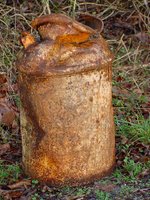
Milk container


Another in the series of Fun Farm Finds, a.k.a. "What the heck is that doing here?!"

My husband found this while clearing some limbs near the driveway. It was filled with largish rocks. He had an idea it might be an old milk can, and he was right. According to that site, "Until the adoption of farm bulk tanks and tanker trucks in the 1940's and 50's milk was stored, cooled and transported in cans."

Interesting, but we still have no idea how it came to be squished, lying in a low area, and filled with rocks.

Just another farm mystery...

--

I've been forgetful, and neglected (among other things) to mention the latest installments of Festival of the Trees and Circus of the Spineless. And of course there's always the Friday Ark.

Just Taking it Easy...

It has been a week since my return. My timing was terrible (that's not exactly the word that went through my mind, but this is a “family friendly” blog). Somehow I had forgotten that it was Labor Day weekend, in both the U.S. and Canada (though there it was Labour Day). And I probably should also have looked a little closer at the map for a different port of entry... getting onto I-5 after crossing into the States was not a good decision on my part.

After I left Hope on Friday morning (September 3rd) there was a considerable amount of traffic on Highway One – it did, after all, go to Vancouver. It may see strange, but I was totally unprepared, psychologically, for all of the businesses and the stores and the amount of traffic on Interstate Five! It wasn't exactly culture-shock, more like sensory overload. Too much all at once. It didn't take long before my nerves were shot!

Almost on the verge of Panic, I exited onto the first highway I saw that would take me away from there – Washington State Road 20. I got through the heaviest traffic area and on past Sedro Woolley. The first State Park that I came to had a “Campground Full” sign, the second park was closed, the third one didn't have a campground. Not good. Then I got to the little town of Rockport. And they have a Municipal Park with a beautiful campground along the river. All of the RV sites were taken but there were still a few tent sites available. Lucky me! It was early afternoon but I stopped for the night anyway. No telling what, if anything, would be available on down the road. It took a while for my nerves to get settled. A nice hot shower helped immensely as did sitting down by the river and watching the water flow by.

Saturday morning, looking at the map, I realized that if I continued east on State Route 20, I'd be going through the Cascade Mountain Range and through the middle of North Cascades National Park. Neither of which would be bad, by any means, but I needed internet access and/or a cell phone signal. So it was back towards Sedro Woolley.

With my errands completed, and because the clouds had blocked out the sun, I decided to go south a short ways on I-5 to Everett and pick up U.S. Route 2, which is a scenic highway through the southern Cascades and Wenatchee Mountains. When I got over Thompson Pass, the clouds disappeared and I saw sunshine and blue skies once again. It was a beautiful drive though I took no pictures to prove it! The landscape changed as I drove east on the other side of the mountains. Fewer trees, brown hillsides, open vistas.

Near Wenatchee U.S. 2 joins up with U.S. 97 and turns north, following the Columbia River, so I did too. Highways run along both sides of the river, I stayed on the west side on the “alternate” route and stopped at the small town of Entiat where there was a municipal park and campground alongside the river. It was almost perfect. Large trees shaded the campground and dotted the riverside. Two nights I spent there, soaking up the sunshine and basking in the warm temperatures (low 70s) and light breeze, generally just taking it easy.

The view from my campsite, looking northeast.
Looking southeast.
From the north side of the park, looking toward the west. The campground was nestled amongst the trees on the western shore.

Sunday, November 7, 2010

Sand Piles that Move

We have had awful wind storms this past week. Here are some of the sand piles that we now have in different places than they were in before. The fence in the first photo used to be 4 feet high, now it is about 3 feet. You can see some dog tracks in the some photos.